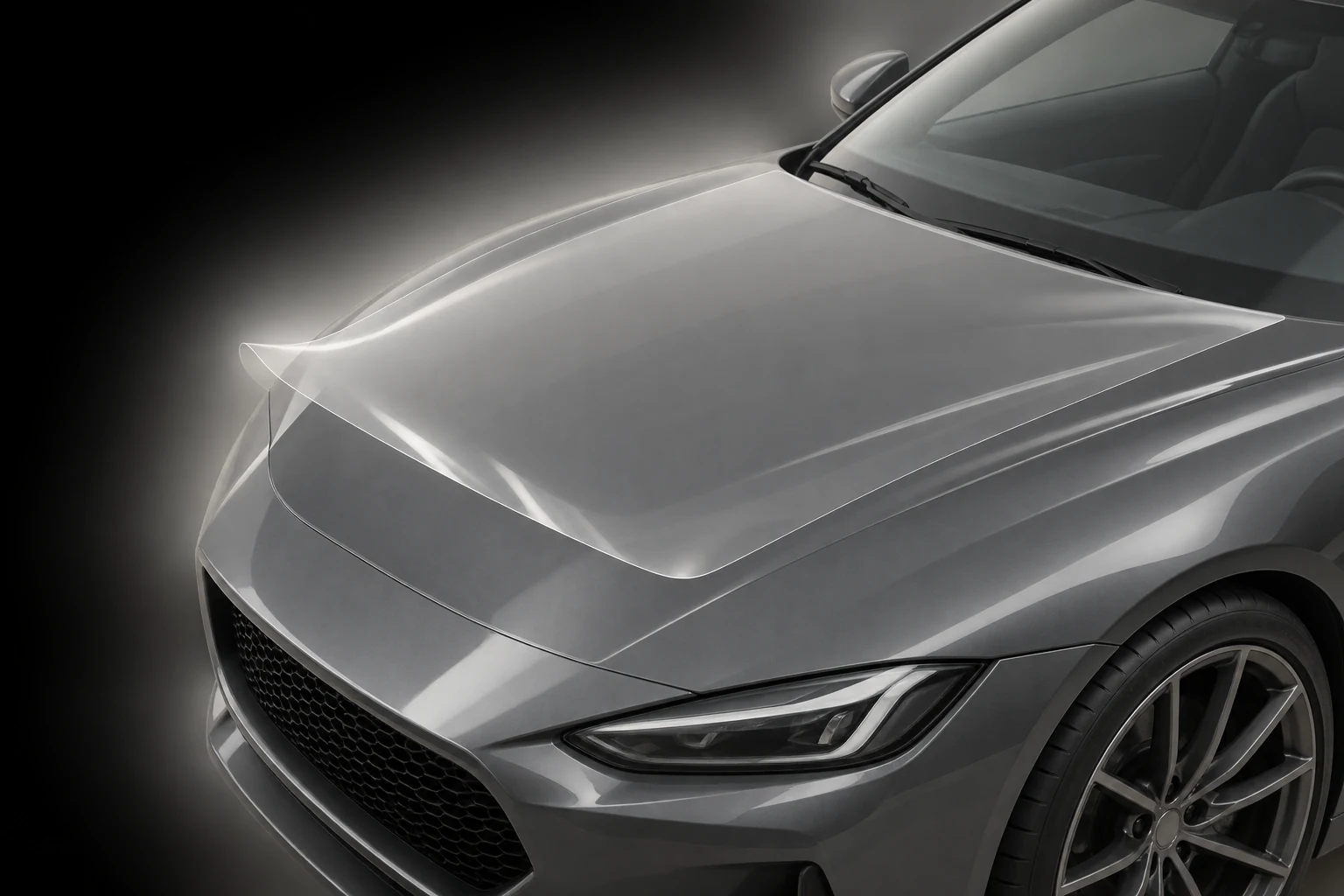
You bought the vehicle because you like driving it. Protecting its finish should help you enjoy it, not make you afraid to take it out of the garage.
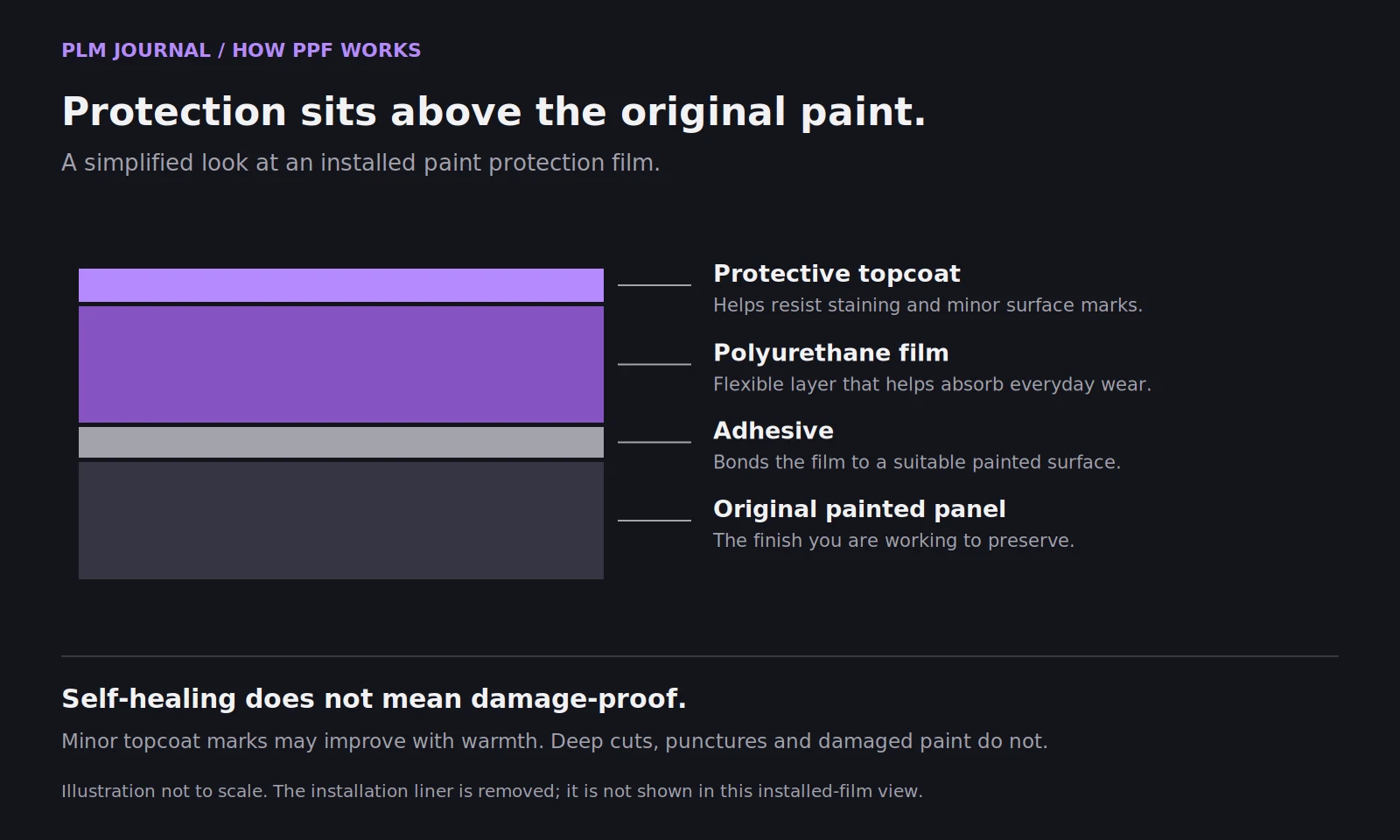
Paint protection film, or PPF, is a flexible protective film installed over automotive paint to help reduce damage from small road debris, light abrasion, and everyday exposure. Modern polyurethane films can also have a self-healing topcoat that reduces the appearance of minor surface marks; that does not make the vehicle damage-proof. PURE PPF explains the material and its limits.
The next question is not simply whether to install PPF. It is how much of your vehicle you want to protect.
What is PPF, and how does it work?
Think of PPF as a replaceable layer between your paint and the outside world. PURE PPF’s clear film combines a protective topcoat, a flexible thermoplastic polyurethane layer, and adhesive that holds the film against the painted surface. See PURE PPF’s layer construction.
“Clear bra” is another name you may hear for clear paint protection film. Clear film is designed to let the original color show through, while matte and colored PPF offer different appearances as well as protection. Explore PURE PPF’s clear film and colored-film explanation.
Coverage and finish are separate decisions. First decide which panels need protection; then decide whether you want to preserve the gloss, create a matte appearance, or explore a color change.
The main PPF application types
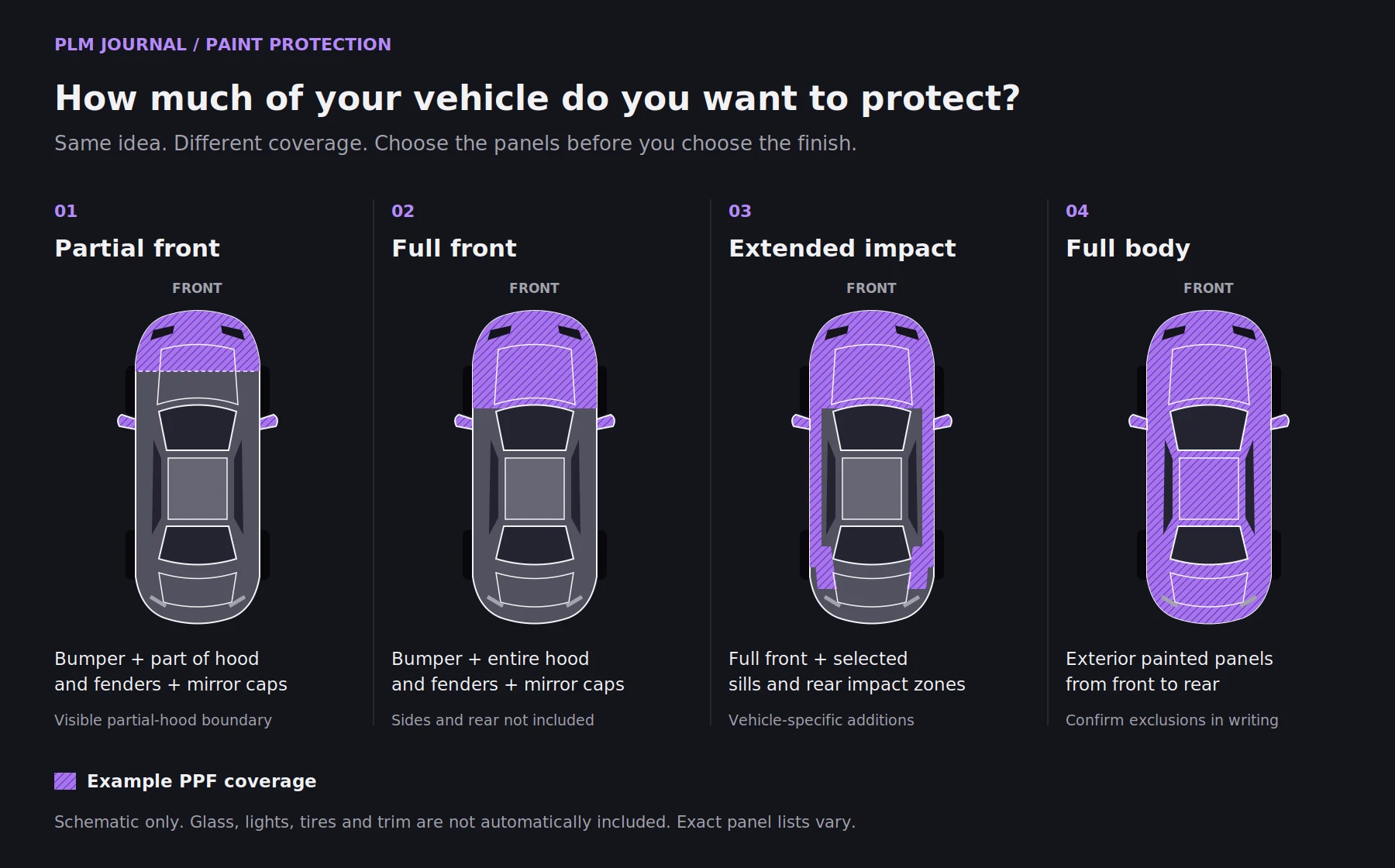
The common coverage levels are partial front, full front, extended-impact or track coverage, and full body. Package names are not a substitute for a written panel list, because inclusions can vary by vehicle and installer. PURE PPF’s coverage overview.
Partial-front PPF: targeted protection up front
A typical partial-front package covers the front bumper, the leading portion of the hood and front fenders, and the mirror caps. It concentrates film on selected forward-facing areas without covering the entire hood or vehicle. PURE PPF package definitions.
The trade-off is the coverage boundary: there is a film edge across the hood, and the uncovered portion remains exposed. PLM’s existing coverage guide describes that partial-hood edge, while its service page includes the bumper in partial-front coverage. PLM coverage guide and PPF service page.
Our recommendation: consider partial-front coverage when controlling the initial cost matters most. Ask to see an example of the hood edge before deciding.
Full-front PPF: the practical starting point
Full-front coverage typically includes the entire hood, both front fenders, the front bumper, and mirror caps. Covering the whole hood removes the partial-front boundary across its painted surface, although installation seams and exposed edges can still exist elsewhere. PURE PPF package definitions.
This does not cover the entire vehicle: doors, rear panels, and roof generally sit outside the basic full-front package. PLM’s published scope also lists A-pillars and headlights, but those details need specific discussion because PURE PPF’s manufacturer warranty excludes headlights and other listed non-painted surfaces. PLM’s published scope and PURE PPF warranty exclusions.
Our recommendation: start the conversation here if you want substantial front-end coverage with no film boundary across the middle of the hood. Then decide whether your driving calls for additional panels.
Extended-impact or track coverage: beyond the front bumper
An extended-impact package builds on full-front coverage with selected vulnerable areas, such as rocker panels, lower doors, and rear impact zones near the wheels. The exact combination varies; “track pack” is a coverage description, not a promise that damage cannot occur on a track. PURE PPF package definitions and PLM coverage examples.
Our recommendation: consider this option when you want to protect more than the front without choosing full-body coverage. Ask the installer to identify the specific impact zones on your vehicle rather than relying on a generic package name.
Full-body PPF: the broadest painted-panel coverage
Full-body coverage extends film across the exterior painted panels, including the hood, fenders, doors, roof, rear quarters, trunk or tailgate, and painted bumpers. The written scope should identify exceptions, especially glass roofs, trim, textured surfaces, and areas such as door jambs that may require separate work. PLM PPF coverage and PURE PPF package definitions.
Full body means broader coverage, not stronger protection against every hazard. It does not turn the film into armor or eliminate the need to wash and maintain the finish. PURE PPF’s protection limits.
Our recommendation: consider full-body coverage when preserving the appearance of the whole vehicle is the priority, particularly if you plan to keep and enjoy it for years. It is a choice about how much paint you want covered, not a requirement for every car.
Custom coverage and finish options
You can also ask about individual panels or small wear areas, such as a painted loading ledge, door cups, or door edges. Treat these as vehicle-specific requests that require confirmation of material suitability and written scope, not assumed package inclusions.
Clear, matte, and colored films answer a different question: how should the vehicle look? A color-change PPF installation combines a new appearance with protective film, while clear coverage aims to retain the original color. PURE PPF’s finish options.
What does PPF protect against?
PPF is designed to reduce certain kinds of everyday paint damage, not prevent every possible mark. Protection depends on the film, installation, condition, and severity of the contact. PURE PPF’s protection explanation.
- Small road debris: the film provides an impact-resistant layer against some rock chips and road wear, but a sharp or forceful strike can penetrate it. PURE PPF.
- Light abrasion: minor scuffs and fine surface marks may affect the film rather than the paint, and compatible self-healing topcoats can reduce some shallow marks with warmth. PURE PPF clear-film specifications.
- Surface contamination: the topcoat can resist staining and help repel liquids and grime, but it is not a reason to leave contamination on the car or skip cleaning. PURE PPF product information and care-related warranty requirements.
Just as important is what PPF does not promise. Deep cuts, punctures, severe impacts, and damage underneath the film are outside the meaning of “self-healing”; the topcoat cannot rebuild missing film or repair damaged paint. PURE PPF’s self-healing explanation.
Do not buy PPF expecting it to prevent dents, hail damage, or collisions. It is a surface-protection product, not body armor, and the manufacturer excludes road-debris damage, normal wear, and acts of nature from its defect warranty. PURE PPF warranty.
Why PPF can be a good investment
The strongest reason to buy PPF is straightforward: you want to preserve a finish you care about while continuing to use the vehicle. We recommend thinking of it as preventive care, not a financial product with a guaranteed return.
Because film is designed to take some surface wear before the paint does, it can help reduce the chance of certain cosmetic damage to covered areas. That is the practical value of a sacrificial protective layer. PURE PPF’s material and protection explanation.
Whether that value justifies the cost is a personal decision. Compare the installed quote with how long you expect to keep the vehicle, how you drive it, how much visible wear bothers you, and whether you would otherwise pay to correct that wear.
Here is our decision framework:
- You want protection where it matters most: start with a full-front quote and compare it with partial-front coverage.
- You want additional impact-zone coverage: ask for an extended-impact package tailored to the vehicle.
- You want to preserve the whole exterior: compare full-body coverage with the cost and limitations of a smaller package.
- You want a new appearance too: review matte or colored PPF samples alongside the protective coverage.
Do not assume PPF will pay for itself at resale. We would not promise a specific resale premium, freedom from repainting, or dollar-for-dollar recovery of the installation cost.
What about ceramic coating?
PPF and ceramic coating are not interchangeable: film provides a physical protective layer, while coating is primarily a surface treatment rather than equivalent chip protection. For a deeper comparison, see PLM’s PPF vs. ceramic coating guide.
Do not assume any coating can safely go over any film. PURE PPF specifically warns that problems caused by non-approved coatings or chemicals are excluded from its manufacturer warranty, so product compatibility should be confirmed before combining treatments. PURE PPF coating disclaimer.
What to ask before booking
A good quote should make the choice easier, not leave you guessing. Ask for these details in writing:
- Exact coverage: which panels, edges, and small wear areas are included?
- Exact film: what product and finish will be installed?
- Paint condition: does existing damage or a repainted panel change the plan?
- Preparation: what cleaning or paint correction is included?
- Warranty: what is covered, what is excluded, and who handles a claim?
- Aftercare: when can you wash it, which products are approved, and when should you return for inspection?
Manufacturer warranty length is not a promise that film will last that long on every vehicle. PURE PPF currently publishes a 12-year limited warranty for clear and matte films and 10 years for colored films, subject to its authorization, substrate, installation, maintenance, and other terms; its written policy excludes repainted surfaces and installation errors. Read the complete PURE PPF warranty.
Protect the way you drive
You do not need the largest package just because it exists. You need a clear explanation of what will be covered, what will remain exposed, and how that choice fits your vehicle.
Start with Private Label Motorsports’ paint protection film service and request a vehicle-specific quote. Tell us what you drive, how you use it, and whether you want targeted front-end protection or coverage across the entire body.